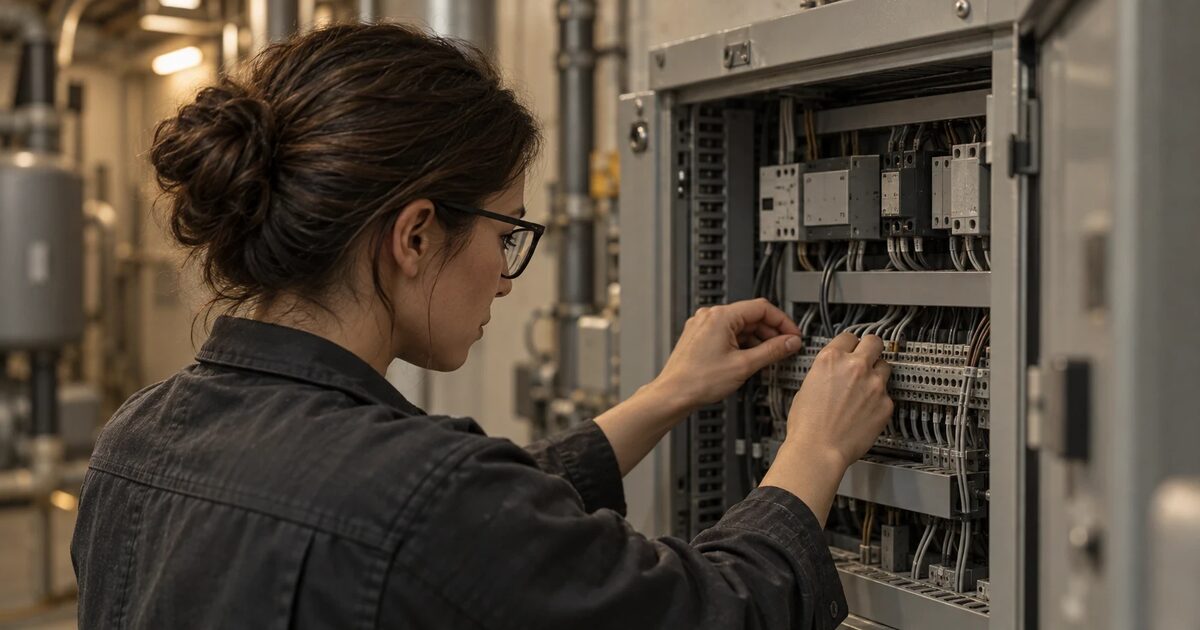
Essay25 min read
Eyes up.
The screen has been moving toward the work for forty years. The face is the last stop before it disappears.

Lorne FadeFounder and CEO of Skill Reality. Co‑Founder and COO of VR Vision. Toronto.
A machine on a bottling line has stopped. A worker is standing in front of it. A part needs to come out and a new one needs to go in, and he does not know the order. He is wearing a pair of glasses. In the corner of his vision, without lifting a hand or looking away from the machine, the order appears. First step. He does it. Second step. He does it. A few minutes later the line is running again and nobody with twenty years on it had to walk over.
I watched that happen. I had spent the decade before it watching something that looked like it and was not.
Since 2016 I have helped build VR Vision, which makes virtual reality training for energy, utilities, manufacturing and automotive companies. I have watched hundreds of people put on a headset for the first time. The pattern never changes. They need the tutorial. They learn the controllers. Ten minutes in it gets easy, and then they are doing their job in a place where the job cannot hurt them. More than a hundred thousand technicians have been through those programs. I am proud of every one of them.
Here is the thing the case studies never say out loud. The headset never goes to the floor. It lives in a training centre, a dojo, a quiet room with a mat on the ground and a sign on the door. The worker practises in there, takes the headset off and walks out to the job carrying nothing but what they remember.
The bottling line was different because the technology went with him.
That difference is what this essay is about. It is the difference between practising and doing, between a room and a shift, between a screen you look at and a layer you look through. I think it is the most important change in how people work since the phone went into the pocket, and I think most of the people it will affect have not heard of it yet.
So I am going to try to lay out the whole picture. How we got here. What hands-free guidance is and what it is not. Every job I can see it touching. What will go wrong. And what comes after the glasses, because something does. I will name companies and I will make bets. Where I do not know, I will say so and leave you the question.
Part IThe screen has been moving toward the work for forty years
From the desk to the pocket to the face
My mother bought me my first computer when I was eleven. I grew up in Toronto and spent most of my childhood on that machine, then studied computer science at York University and turned the tinkering into a trade. I mention it because the whole arc of my working life sits on one movement: the screen getting closer to the person.
The desktop lived on a desk and you went to it. The laptop came with you, but it still needed a flat surface and both hands. The phone went into your pocket and took one hand. The watch took no hands at all, and in exchange it could tell you almost nothing. Every step traded capability for proximity, and every time, proximity won. Nobody chose the phone because it was the better computer. They chose it because it was there.
In 2004 I founded Academic Ads, a digital marketing company in the early days of online advertising, and scaled it to millions in revenue. The lesson of those years was simple and I have never seen it fail. Attention goes where the screen is. Money follows attention. In 2014 the partnership ended, I sold the business and started again from zero. That is a story for another day, except for one thing it taught me: a restart makes you look for the next movement instead of defending the last one.
2016, the year the screen wrapped around your head
The Oculus Rift shipped to consumers in 2016. The same year Roni Cerga and I co-founded VR Vision. The bet was that practice beats lecture, and that a simulated substation, a simulated line and a simulated confined space would let people rehearse the dangerous and expensive parts of their jobs until those parts were boring.
It worked, and it worked for a reason worth being precise about. Virtual reality is good at one thing above all others: it gives people a safe place to practise. Switching in a substation. Entering a confined space. Running a procedure on a line where an hour of downtime costs more than the training budget. The headset replaces the world with a version of it that forgives mistakes, and people learn faster when mistakes are free.
Its weakness is the same property. It replaces the world. Inside a headset you cannot see your hands, your tools, the machine or the colleague shouting over the noise. So the headset went where that weakness did not matter: the training centre. Companies built dojos for it. The good ones built whole curricula around it. The automakers, utilities and bottlers we worked with did real things with it, and the people who went through it came out better at their jobs.
But I have never once seen a headset on a plant floor during a shift, and I do not expect to. That is not a criticism of the headset. It is a description of what it is for.
The best training technology we have ever shipped has a wall around it, and every shift starts on the other side of it.
The graveyard, and the wrong lesson people take from it
Google put a camera and a tiny display on a pair of frames in 2013 and called it Glass. The consumer version became a punchline. The enterprise version survived for a decade in warehouses and on factory floors, and Google stopped selling it in March 2023. Microsoft launched HoloLens in 2016, shipped a second one in 2019 and in late 2024 told customers it was ending production with no successor. Apple shipped Vision Pro in February 2024, a remarkable piece of engineering that is also, unmistakably, a headset.
The lesson most people draw from this is that computers on the face do not work. I think that is exactly wrong, and I think the people who draw it are about to be surprised.
Each of those products failed for a reason that has since been removed. Glass was a camera with a notification feed and no reason to exist on anyone’s face. HoloLens was a kilogram of hologram sold to people who needed a checklist. Vision Pro is a cinema you wear. And all three shared a deeper problem: there was nothing behind the glass worth looking at. No model could read your procedure and tell you the next step. Hardware without that is jewellery.
What changed in 2025
In September 2025 Meta shipped the Ray-Ban Display: a pair of glasses that look like glasses, with a small colour display in one eye and a wristband that reads your intent from the muscles in your wrist. It costs about what a phone costs. Google’s Android XR arrived with Samsung and eyewear brands behind it. RealWear, which has been quietly selling rugged head-worn displays into industry for years, including versions certified for hazardous areas, kept doing exactly that, and suddenly looked less like a niche and more like a preview.
The other curve crossed at the same moment. In about a year, language models went from an amusing demo to something that can read a plant’s standard operating procedure and turn it into steps a person can follow. The glass finally had something behind it.
Two curves crossed. That is the whole story of why I started building Skill Reality in May 2026 and founded the company that September, and why I believe the next decade of work technology happens in the corner of a worker’s eye.
The field in 2026, and what is landing in 2027
Since I will be judged on names, here are the names. Meta has the only display glasses a normal person can walk into a store and buy today, and it has shown Orion, a true augmented reality prototype that makes clear where it wants to end up. Google’s Android XR is the other platform, and its first glasses arrive through partners: Xreal’s Project Aura, a wide field of view tethered to a small compute puck, due this fall, and audio-first frames from Samsung with Gentle Monster and Warby Parker, with display versions reported for 2027. Snap is shipping consumer Specs, a standalone pair with a real field of view and a price that says it is for developers first. Apple’s glasses are rumour until Apple says otherwise, and the rumours now point to late 2027 and no display in the first pair.
On the industrial side, Vuzix has been selling head-worn displays into enterprise since before Google Glass existed and now manufactures waveguides for other brands, and RealWear remains the device that is actually certified for the places that need it most. And then there is China, where Rokid, Alibaba and a dozen others are shipping camera and display glasses at prices and volumes the rest of the market has not caught up with. Xreal itself is a Chinese company. Anyone who thinks this is a two-horse race between Meta and Google is not watching the right shelves.
Every date in those two paragraphs will slip. They always do. What will not slip is the direction. By the end of 2027 there will be more display glasses on the market than in the entire history of the category, from more companies at more prices, and the question for anyone who runs a plant will no longer be whether the hardware exists. It will be what to put on it, and who gets to decide.
Part IIWhat hands-free guidance actually is
The procedure problem
Every plant has procedures. Ask anyone who has worked a maintenance shift where they live and you will get a tour: a document system nobody opens on the floor, a binder in the supervisor’s office, a laminated sheet zip-tied to a railing, a photo of a whiteboard on someone’s phone and the head of the one person who has done the job for twenty years. The procedures are written for the auditor, not for the person holding the wrench. They are correct, approved and nowhere near the work.
Hands-free guidance is a plain idea. Take the procedure as written. Have a model author it into steps a person can actually follow while their hands are busy. Put each step in the periphery of the worker’s vision. Let them advance it with their voice, a glance or a flick of the wrist. Record each step as done. That is it.
It is not a hologram. It is not a robot. It is not a replacement for judgment. It is the veteran at your shoulder, on every shift, for every person on the floor.
What “AI-authored” has to mean
The phrase does a lot of work, so let me be exact about it. The model does not invent the procedure. It reads the procedure the plant already approved, the one written for the auditor, and rewrites it for a person with their hands full: one action per step, the tool named, the reading to confirm, the photo of what done looks like. A human who knows the job signs it off before anyone wears it. Then the model keeps it current when the procedure changes, which is the part no plant has ever managed with paper.
I am strict about this because a wrong step on the glasses is worse than a wrong step in a binder. Nobody trusts the binder. People will trust the glasses, quickly, and that trust is the whole value and the whole risk. The model drafts. A person approves. The record shows who.
- 1 · As written
SOP 12.3, pump seal replacement
6.2.1 Prior to removal of the mechanical seal on pump P-204, personnel shall confirm isolation of the suction and discharge valves in accordance with section 3.4, verify zero energy at the local disconnect, and ensure the casing drain is open and the casing has been vented before the gland follower is loosened.
Written for the auditor - 2 · The draft
Step 4 of 18
- Confirm the local disconnect reads zero
- Open the casing drain and vent the casing
- Loosen the four gland bolts evenly. Photo: seal faces before removal
- 3 · The sign-off
Approved
Reviewed by the shift lead who has done the job for twenty years. Two words changed. Then it goes on the glasses.
The record shows who
Why the edge of your vision, not the middle
Everything about display glasses that works, works because the display is off to the side. The first time I ran our own guidance on the Ray-Ban Display, the thing that felt right was not the resolution or the brightness. It was that the instruction sat where a wristwatch sits in your attention: there when you want it, gone when you do not.
Peripheral overlays are the winner here. Checklists, instructions, procedures, a reading to confirm, a picture of what the finished step should look like. Short text and short lines. The worker’s eyes stay on the work. The moment you put a three-dimensional model between the person and the task, you have put a screen in the way again, and you are back to the headset with worse optics.
The best display is the one you can ignore. I would go further. The quality of a piece of guidance is measured by how little of it the worker has to look at.
Every step on the record
The quiet feature is the record. When a step is done on the glasses, it is done at a time, by a person, in a sequence. A lockout confirmed. A torque value spoken. A photo taken at step seven because step seven is where the thing goes wrong. Compliance becomes a by-product of doing the work instead of a chore after it, and the audit trail writes itself.
| Time | Step | By | Confirmed |
|---|---|---|---|
| 14:02:10 | 1 · Isolate the suction and discharge valves | Millwright, shift B | Voice |
| 14:02:48 | 2 · Apply the lockout at the local disconnect | Millwright, shift B | Voice |
| 14:03:35 | 3 · Confirm the disconnect reads zero | Millwright, shift B | Voice |
| 14:05:02 | 4 · Open the casing drain and vent the casing | Millwright, shift B | Voice |
| 14:09:41 | 6 · Loosen the four gland bolts evenly | Millwright, shift B |  Photo |
| 14:10:20 | 7 · Withdraw the seal and inspect the faces | Millwright, shift B | Voice |
That cuts both ways, and I will come back to it in Part IV. For now, notice what it means for the plant. For the first time, the procedure and the work are the same event.
What it is not, yet
Honesty about limits is how you earn the right to make predictions, so here are the limits. A single-eye display is small. A battery is a shift-length problem. Bright sun washes a display out. Safety glasses have to fit over, or be, the glasses. Gloves and voice control in a loud plant are a real fight. And consumer glasses are not rated for hazardous areas, which rules out a great deal of the industrial world on day one.
That is why Skill Reality is live on the Ray-Ban Display, tested on Android XR and prototyped on RealWear. The form factor and design of the consumer glasses are what make workers willing to put them on. The ruggedness of the industrial gear is what makes a safety manager willing to let them. We do not yet have both in one object. The company that builds it will own a very large market, and I do not think that company exists today.
What a good first deployment looks like
I have watched enough technology arrive on a floor to know that the deployment matters more than the product, so here is what I tell anyone starting. Pick one task, not a programme: the repair everyone dreads, the changeover that always runs long, the inspection nobody fills in properly. Pick the veteran who does it best and make him the author. Sit with him for an afternoon, let the model draft his way of doing it, then let him correct it until he is satisfied, which he will not be at first. Put the glasses on the newest person on the shift and let the veteran watch.
Measure one thing: did the task get done right, first time, without a walk back to the binder. Then do the next task. A plant that runs this loop a few times has a different relationship with its own procedures than it had before, and the glasses turn out to be the least important part of it.
Where the three companies meet
People ask how a VR training company, a marketing agency and a glasses company belong to the same person. The thread is one sentence. VR gives people a safe place to practise their job. AI on the glasses gives them guidance when they are doing the real one. And Fade Digital, which I founded in 2024, is about the same thing from the other side: when people ask an AI what to buy or whom to trust, the answer comes from what has been written down clearly. Procedures and brands fail the same way. They exist, and nobody can find them at the moment of need.
Part IIIThe use cases, as far and wide as I can see
People ask me for the list. The honest answer is that the list is every job where a person’s hands are busy and their eyes must stay on the thing in front of them, and where somebody, at some point, wrote the steps down. That is most of the physical economy. But a list is more useful than a slogan, so here is how I sort it. Four things the glasses do, then the places each of them lands.
Show me the next step
Maintenance, changeovers, commissioning, troubleshooting. Anything with a sequence and a cost to getting it wrong.
Check that I did it
Lockout and tagout, permits, inspections, quality. The clipboard, with the proof built in.
Connect me to someone who knows
See what I see. The expert who retired, the one engineer across nine sites, and soon a model before a human.
Remember this for the next person
The veteran’s real sequence becomes the draft of the next procedure. Tribal knowledge, kept.
Show me the next step
This is the bottling line. Maintenance and repair. Changeovers between products. Commissioning a machine that was installed last week. Setting up a line that runs this configuration twice a year, when nobody remembers the configuration. Troubleshooting trees that branch on what the worker sees. Anything with a sequence and a cost to getting the sequence wrong.
It is the least glamorous category and the biggest. Most of the money lost on a factory floor is lost in the ten minutes between a machine stopping and the right person arriving. Guidance does not make the right person arrive faster. It makes the person already standing there the right person.
Check that I did it
Lockout and tagout. Permits to work. Pre-start inspections. Quality checks with a photo at the step and a value spoken into the record. The whole discipline of confirmation that today lives on a clipboard, filled in by a person whose hands were supposed to be on the equipment, often filled in afterwards from memory.
Safety culture is a culture of steps. The industries with the best safety records are the ones that made the steps non-negotiable, and they did it with paper and discipline. The glasses do not change the discipline. They remove the paper, and with it the gap between the step and the proof of the step.
Connect me to someone who knows
See what I see. The expert who retired to Florida and takes one call a week. The one engineer who understands the old control system, spread across nine sites. Remote assistance has been the single most convincing use of head-worn displays for a decade, and it was carrying the weight of hardware that was not ready. It is about to get much easier, and much cheaper, and the person on the other end of the call is increasingly going to be a model before it is a human.
Remember this for the next person
The flip side of guidance is capture. When the veteran does the job in glasses, the sequence they actually follow, which is never quite the sequence in the binder, becomes the draft of the next procedure. Tribal knowledge becomes institutional knowledge one shift at a time. This is the use case I think about most, because it is the one that fixes the problem the other three are working around.
Every industrial company I have ever worked with has the same chart somewhere: the age of its most skilled people against the years until they retire. Nobody has a plan for it that works. Apprenticeship is the plan, and apprenticeship needs two people in the same place at the same time for years. Capture is the first alternative I have seen that does not require the veteran to stop working in order to teach.
The economics nobody talks about
There is a quieter reason the glasses matter, and it is about money rather than vision. A training centre is a capital project. It needs a room, a schedule, a trainer and a worker who is not on the line while he is in it. Guidance on the glasses needs none of that. It is spent per worker, per shift, on the task that is actually in front of them, and it starts paying the day it is switched on rather than the quarter after the course is finished.
For the first time, the budget for teaching a job and the budget for doing it are the same budget. I expect that to change who buys training. I also expect the people who have sold it as a classroom product, my own industry included, to find that uncomfortable, and I would rather say so here than pretend otherwise.
Where it lands first
- Manufacturing and packaging. Changeovers, line clearance, the repair on the bottling line. The density of written procedures per square metre is highest here, and the cost of a stopped line is counted by the minute.
- Utilities and energy. Switching orders in substations, line work, turbine service, gas distribution. The permit culture already thinks in steps, which makes it the easiest place to put steps on the glasses and the hardest place to get a consumer device approved.
- Automotive. Assembly guidance for low-volume variants, end-of-line inspection and the dealer service bay that has a different procedure for every model year and a technician who cannot hold them all.
- Field service and telecom. The technician in a van who sees fifty kinds of equipment a month and cannot be an expert on any of them. The job is already a sequence of unfamiliar procedures. It just has no good place to read them.
- Logistics. Warehouse picking was the one job where the first generation of smart glasses earned its keep. It will be the first to move to the new ones, and it will carry the lessons about battery, fit and the first ten minutes with it.
- Healthcare. Nursing procedures, sterile processing, clinical checklists, the surgical checklist that has been on paper since it was invented. Hands gloved, eyes on the patient, a step to confirm and a record that matters more here than anywhere.
- Laboratories and pharma. Batch records, gloved hands in a hood, every step signed. Already a world of records, with nowhere to put a screen.
- Aviation and rail maintenance. The mechanic’s world already runs on task cards. The card belongs in the eye, not on the wing.
- Construction and the trades. The drawing in view while both hands are in a panel. The inspection sequence for the thing you just built. The code requirement for the thing you are about to build.
- Food service and hospitality. Opening and closing checklists, allergen steps, food safety logs that are currently signed by someone who did not do them.
- First responders. Incident checklists, a dosage read aloud in the back of an ambulance, hands on a patient and no hand free for a tablet.
- Mining and agriculture. Remote, hazardous, high consequence and short of the people who know how. The places where the one expert is a plane ride away.
And then the office, where I think it lands last. The desk already has a screen. The point of the glasses is work where there is no desk.
Here is the test I would offer any reader. Pick any job where someone’s hands are busy and their eyes must stay on the thing. Is there a step in it that someone wrote down? Then it belongs on this list, and someone is going to build it. The only question is whether that someone understands the job or only the glasses.
Part IVThe hard parts, said plainly
The person who does not want to wear it
My biggest worry is not the technology. It is adoption, and specifically the people who have the most to give and the least appetite for something new on their face. Older workers, the ones with thirty years of knowledge, are the least likely to want shiny new tech, and they are exactly the people whose knowledge the system most needs.
The headset taught me something useful here. Nobody wanted that either. Then they did the tutorial and learned the controls, and ten minutes later it was easy. The first ten minutes decide everything. So the glasses have to look like glasses, not a gadget. The first task has to be one the worker already hates doing the old way. And the pitch to a millwright with thirty years in is not the future. It is this: you will never walk back to the binder again.
Most of all, make the veteran the author, not the student. If the way he does the job becomes the guide the apprentice follows, he is not being replaced by the glasses. He is being published.
The pitch to a millwright with thirty years in is not the future. It is that he will never walk back to the binder again.
Who reads the record
Every step on the record is a safety feature or a surveillance feature depending on who reads it and why. I do not think that question gets to be answered by default, and I think the default, if we let it happen, will be the wrong one.
Does the worker see their own record first? Is it used to defend them when something goes wrong, or to time them? Does the same record that proves a lockout was done get used to measure how long they took to walk back? Can a supervisor watch the camera, or only the steps? Who is in the room when the policy is written, and is anyone there who will wear the glasses?
This is not theoretical. As I write, Norway’s government is proposing a temporary ban on smart glasses in some public places, and the European Union’s data watchdog is recommending that glasses show clearly when they are recording. Those fights are about the street. The workplace will get its own version, and it will be harder, because at work the person wearing the camera and the person being recorded are often the same person.
Here is where I land, and I hold it as a design rule rather than a policy. The record belongs to the work, not to the watching. It exists to prove the step was done and to make the next person better at it. The day it becomes a stopwatch is the day the veterans take the glasses off, and they will be right to.
Does guidance make skill, or replace it
If the glasses always tell you the next step, do you ever learn it? I take this seriously, because the honest answer is that it depends entirely on how the guidance is built.
Training taught me the distinction. Guidance that never fades is a crutch. Guidance that fades is a teacher. A good guide shows less over time, and the system should know when to be quiet: the first time through, every step; the twentieth time, only the step where people get it wrong. Skill on the job is the goal. The glasses are a means to it, and they should be designed to be needed less.
- Confirm the disconnect reads zero
- Open the casing drain and vent the casing
- Mark the gland follower position
- Loosen the four gland bolts evenly, a quarter turn each
- Withdraw the seal and inspect the faces
- Confirm the disconnect reads zero
- Open the casing drain and vent the casing
- Mark the gland follower position
- Loosen the four gland bolts evenly, a quarter turn eachthe step people get wrong
- Withdraw the seal and inspect the faces
Which raises the question I find hardest. When a novice with glasses can do an expert’s job, what is the expert for? My answer, for now, is this: for the moment the procedure is wrong. Every veteran knows the procedure is sometimes wrong. The glasses do not. Someone has to.
The thing on your face is still a consumer product
Hazardous area certification. Information security in a plant that already forbids cameras. Prescription lenses. Battery life across a long shift. Plant networks that were never designed for a device that talks. A camera on every face in a facility that has spent years keeping cameras out. None of this is glamorous and all of it is where the next few years of work go. The companies that treat these as the product, rather than as obstacles to the product, are the ones that will still be on the floor at the end of the decade.
Whose knowledge is it
When a model has learned a veteran’s sequence, who owns it? The company that employs him? The vendor whose software captured it? The person whose hands did it ten thousand times? I do not have a settled answer, and I am suspicious of anyone who does.
I do have a precedent. I spent the first decade of my career in online advertising, in the years when attention became an asset. The people who generated it never owned it, and most of them never knew it had been sold. I would like the people who generate skill to do better than that, and I think the answer starts with the worker seeing, and keeping, their own record. If this industry gets one thing right that the last one got wrong, I hope it is that.
Part VWhat comes after the glasses
Three horizons
Here is where I put my name on the future, with the caveat that anyone who gives you dates for this is guessing, including me.
The first horizon is now. Consumer display glasses on the floor in pilots, in the jobs that do not need certification. Single-eye displays. Voice as the main control. And, in parallel, work that cannot have anything on the eyes going to the ear instead.
The second horizon is intrinsically safe safety glasses with a display: personal protective equipment first, computer second. That is a harder object than it sounds, because batteries and radios in hazardous zones are a serious engineering and certification problem, and the people who are good at eyewear are not the people who are good at that. But when it exists it gets issued like a hard hat, and that is the moment this stops being a pilot and becomes a line item.
The third horizon is far off: a display in a contact lens. The screen disappears entirely. At that point the question flips from “will you wear it” to “do you want a layer at all”, and I honestly do not know how people will answer. I am not sure I know how I would.
The ear before the eye
I think the ear reaches more workers than the eye in the next few years, and I say that as someone building for the eye. An earpiece that listens and talks is cheaper, already worn, invisible and acceptable in places a camera will never be. For a great many jobs, “next step” read aloud and “done” said back is enough. The glasses win where you need to see a value, a diagram or a photo of what right looks like. Build for both, and let the job pick.
Beyond wearables entirely
Now the question I actually want to leave you with. What if the guidance is not on the person at all?
The machine that knows its own procedure and lights the next bolt. Guidance projected onto the workbench. A tool that refuses to torque the wrong fastener. Three robots doing the task while one person supervises them through glasses, and then through nothing. If the instruction can move from the binder to the glasses, it can move from the glasses into the tool, and from the tool into the machine, and at that point the human on the floor is doing something different from what we call work today.
It may be that the glasses are a bridge: the period in which people still do the work and need the instruction, before the instruction moves into the thing being worked on. Bridges matter. The phone was supposed to be a bridge too.
Five bets, so you can hold me to them
A ledger rather than a list, because a prediction without a date and a status is just a mood. I will come back to this block as the facts land and change the status, with a note of what changed and when.
- 01
Display glasses will be issued as standard equipment, like a hard hat, in at least one hazardous industry before the end of this decade, and the first ones will not come from a consumer electronics company.
- 02
No headset, however good, will go onto a plant floor during a shift. The headset’s future is the training room, and that is a good future.
- 03
The ear will reach more frontline workers than the eye in the next few years, and most of the companies building for the eye, mine included, will end up building for both.
- 04
The first serious fight over these devices will not be about safety or battery. It will be about who can read the record, settled plant by plant.
- 05
The procedure will leave the glasses and move into the tool within my working life, and the question of what a skilled worker is will have to be answered rather than assumed.
Questions I cannot answer yet
- When the procedure lives in the tool, what does the worker need to know, and who decides?
- If the expert’s value is the moment the procedure is wrong, how do you train for that moment when every other moment is guided?
- Will companies pay for skill, or for compliance? They look the same on a purchase order and they are not the same thing.
- Who is liable when the step on the glasses was wrong?
- What happens to the apprenticeship, the oldest form of training there is, when the person you stood next to for four years becomes a layer in your vision?
- Is the goal of all this more screens, or fewer?
I have an answer only to the last one. Fewer. The last screen we build should be the one you forget you are wearing.
CloseEyes up
Back to the bottling line. The worker finished the repair, confirmed the last step and kept working. He did not take anything off. He did not walk anywhere. He did not need the person with twenty years, and the person with twenty years was free to do something only he could do.
Twenty years ago I was putting advertisements in front of people’s eyes. Ten years ago I was wrapping screens around their heads. The work now is to put the least possible thing in the corner of a person’s vision and get out of the way.
Eyes up. Hands free. The job in front of you.
Lorne FadeToronto, October 2026. Founder and CEO of Skill Reality. Co‑Founder and COO of VR Vision. Founder of Fade Digital.